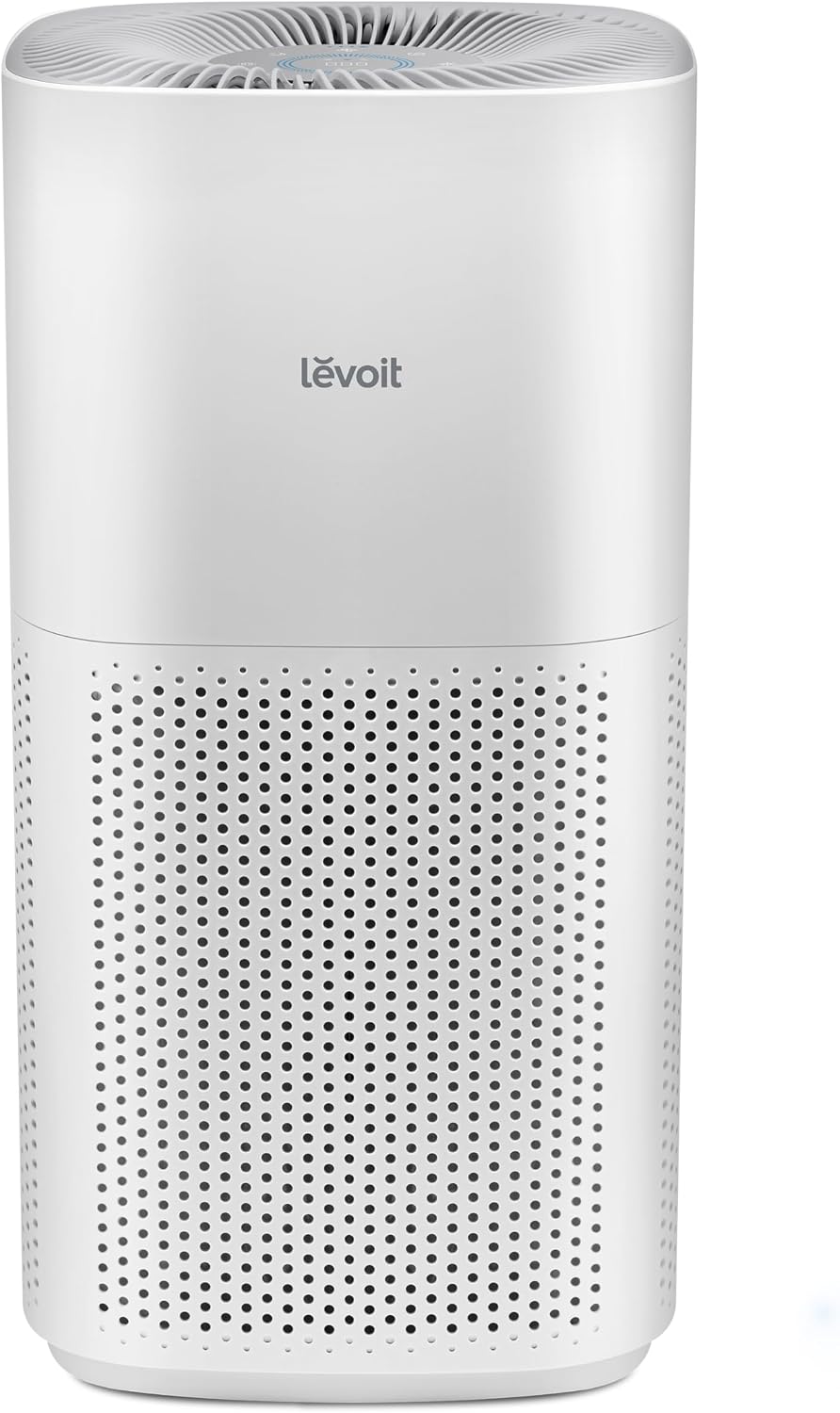
The box is lying, and it’s been lying for 20 years
Every air purifier box, every Amazon listing, every Wirecutter recommendation has a square-footage number: “Effective up to 1,300 sq ft.”
Here’s what that number actually means, in the most honest terms possible:
The purifier will exchange the air in a 1,300 sq ft room once per hour, on the loudest setting, in a lab, with no doors, no pets, no cooking, no human breathing, and no smoke coming in through the window.
That’s 1 ACH. One air change per hour.
And 1 ACH is the minimum for a room that’s already clean and just has a little dust. For a bedroom where you want to sleep through wildfire smoke, or a living room where you want to actually reduce your allergen load, the target is 4–5 ACH.
So a “1,300 sq ft” purifier, at the effective 4.8 ACH target, only effectively cleans a room of about 260–325 sq ft. That’s a bedroom, not a house.
This is why the most common complaint in r/AirPurifiers is: “I bought a purifier rated for 1,300 sq ft, put it in a smaller room, ran it 24/7, and notice literally no difference.”
You didn’t notice a difference because you were running it at 0.3–0.5 ACH, not 4.8 ACH. The box lied to you, and the box’s lie is structural — it’s built into how the number is calculated.
The honest formula
Forget the square-footage number. It’s a marketing artifact. Use the Smoke CADR instead.
Smoke CADR is measured in CFM (cubic feet per minute) — it’s a rate. It tells you how many cubic feet of air the purifier filters per minute, for the hardest-to-capture particles.
The formula for ACH:
ACH = Smoke CADR (CFM) ÷ Room Volume (cu ft)
For an 8-ft-ceiling room (the standard assumption):
ACH = Smoke CADR ÷ Room Area (sq ft)
The target: ACH ≥ 4 for a bedroom, ≥ 3 for a living room.
Worked example
You have a 12×14 ft bedroom (168 sq ft, 8 ft ceiling, 1,344 cu ft).
| Purifier | Smoke CADR | ACH in your bedroom | Verdict |
|---|---|---|---|
| “1,300 sq ft” purifier | 150 CFM | 150/168 = 0.89 ACH | Useless — less than 1 ACH |
| Levoit Core 400S | 240 CFM (Smoke) | 240/168 = 1.43 ACH | Barely a dent |
| Levoit Core 600S | 280 CFM (Smoke) | 280/168 = 1.67 ACH | Still below 1.5 ACH |
| Corsi-Rosenthal box (16x20x1 filter) | ~800 CFM | 800/168 = 4.76 ACH | ✅ Effective |
| Two Corsi-Rosenthal boxes | ~1,600 CFM | 1,600/168 = 9.5 ACH | ✅ Overkill, fast reset |
The pattern: the commercial purifiers with the impressive “1,300 sq ft” label are actually running your bedroom at under 2 ACH — less than half the effective target. The $75 DIY box is running it at 4.76 ACH — the actual target.
This is the single most important insight in air purifier buying, and no commercial site states it this clearly.
Why manufacturers inflate the square-footage number
The square-footage number is calculated at 1 ACH on the highest setting. It’s a legitimate calculation — it’s just the worst case of the purifier’s performance.
Here’s the math a manufacturer uses:
Advertised sq ft = Smoke CADR (on high) × 60 / 0.75
The × 60 converts per-minute to per-hour. The / 0.75 is an AHAM fudge factor that accounts for real-world inefficiencies. But the result is a number that assumes you’ll run the purifier on high, all the time, in a sealed room.
In reality:
- You run it on auto mode, which typically sits at 30–50% of max speed.
- The room is not sealed — doors, windows, HVAC.
- You’re breathing — adding CO2 and moisture.
So your actual ACH is 0.2–0.5 of the advertised value. A “1,300 sq ft” purifier that advertises 1 ACH in a 1,300 sq ft room is actually running your 168 sq ft bedroom at 0.2–0.4 ACH. That’s why you notice nothing.
The 4.8 ACH rule (and why)
Where does 4.8 ACH come from? It’s the EPA’s and AHAM’s recommended minimum for effective air cleaning in a typical residential room. The logic:
- Particles don’t all pass through the filter in one pass. A particle enters the purifier’s intake, but only ~30–60% of the air in the room passes through the filter in a single “exchange.” The rest recirculates around the room.
- To get 95% of particles captured, you need ~3 effective passes. 0.95 = 1 − (0.35)^3 ≈ 0.93 (where 0.35 is the single-pass capture efficiency).
- To get 3 effective passes per hour, you need ~4.8 ACH. Because each “air change” only captures ~35% of the particles in the room.
So 4.8 ACH is not an arbitrary target. It’s the math of particle capture. Below 3 ACH, you’re mostly moving air. Above 5 ACH, diminishing returns set in.
What this means for buying
Rule 1: Ignore the square-footage number. It’s a marketing artifact calculated at 1 ACH on high.
Rule 2: Look at the Smoke CADR. It’s the honest number. If it’s not listed, look at the AHAM Verifide rating — the Verifide number is the verified Smoke CADR.
Rule 3: Calculate your ACH. Divide the Smoke CADR by your room’s square footage (for 8 ft ceilings). Target 4+.
Rule 4: Buy the purifier that hits 4+ ACH in your room, not the purifier with the biggest square-footage number. A “500 sq ft” purifier with a Smoke CADR of 240 CFM will outperform a “1,300 sq ft” purifier with a Smoke CADR of 150 CFM in a 168 sq ft bedroom.
Rule 5: Consider the DIY Corsi-Rosenthal box. It’s the only product in the market with an honest performance number: a 16x20x1 HEPA filter on a box fan, moving ~800 CFM. At $75, it beats every $300–600 commercial purifier on ACH-per-dollar. We cover it in a dedicated article.
The bottom line
The square-footage number on the box is the single biggest lie in air purifier marketing. It’s calculated at 1 ACH on the loudest setting in a sealed lab — the worst case of the purifier’s performance.
Use the Smoke CADR. Calculate your ACH. Target 4+.
A purifier that hits 4+ ACH in your room will genuinely change what you breathe. A purifier that hits 0.5 ACH — which is what most “1,300 sq ft” purifiers actually do in a normal bedroom — will not.
That’s the difference between a product that works and a product that makes you feel like you’re doing something.