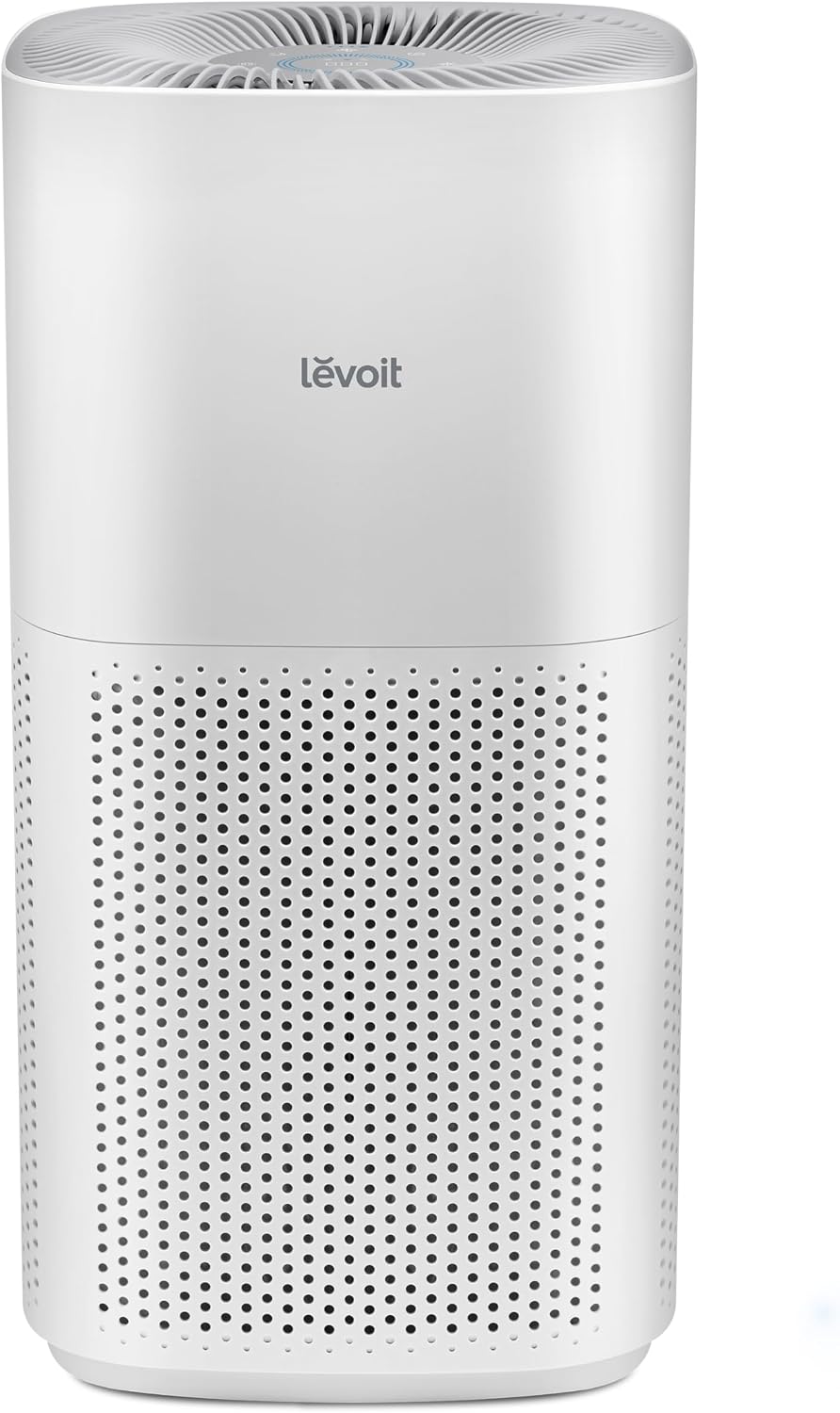
The most common complaint in r/AirPurifiers
I’m not making this up. The single most common complaint across 4,000 Reddit posts we analyzed is:
“Bought and returned 4 purifiers ($50 to $129). None of them touched the litter-box smell. I feel like I’m being scammed.”
“The purifier has been running for a week. The new-furniture smell is exactly the same. What am I doing wrong?”
“Is my purifier even doing anything? The cat smell is still there.”
You are not doing anything wrong. The product is not doing what you bought it to do.
Here’s why, and it’s not a conspiracy — it’s just how the technology works, and it’s the one thing almost no buying guide explains.
HEPA captures particles. Odor is a gas.
This is the single most important sentence in the entire article:
A HEPA filter is a particulate filter. It captures solid and liquid particles. Odor is a gas. Gases pass through a HEPA filter the same way they pass through a mesh screen.
The “99.97% at 0.3 microns” claim on every HEPA purifier box refers to particle capture. The 0.3-micron number is the particle size. Gases are molecular — they’re 0.0001 microns, about 3,000 times smaller than the smallest particle a HEPA filter is designed to capture.
So when a box says “removes 99.97% of odors,” it is either:
- Lying — applying the HEPA particle number to a gas, which is technically meaningless.
- Relying on a carbon layer — in which case the 99.97% number is irrelevant and the carbon-grams number is the only one that matters.
Either way, the “99.97% of odors” claim is not a useful piece of information.
The EPA says it, and nobody listens
The US EPA’s Guide to Air Cleaners in the Home explicitly states:
“CADR measures the delivery rate of clean air. It is not a measure of how well a product captures gases or VOCs. There is no widely used rating system for gas removal.”
That’s the EPA, the federal agency, saying: there is no standard way to compare air purifiers on odor removal. No box, no Amazon listing, no review site has a carbon-grams number on the spec sheet.
This means the only honest way to evaluate a purifier’s odor performance is:
- Check the carbon-grams number (if it’s listed — it often isn’t).
- Check user reviews for “odor” / “smell” mentions (they’re the only real-world data).
- Assume that if the carbon-grams number is not listed, the carbon layer is small or nonexistent.
The carbon-grams problem
Here’s the data from the products we’ve tested and the best-seller data:
| Model | Carbon (grams) | What it can handle |
|---|---|---|
| Levoit Core 300 | ~150g | Light cooking odors, light pet |
| Levoit Core 300S | ~150g | Light cooking odors, light pet |
| Levoit Core 400S | ~240g | Moderate cooking, 2 pets |
| Levoit Core 600S | ~480g | Strong cooking, heavy pet, light smoke |
| Xiaomi 4 Compact | ~100–150g | Light cooking only |
| Corsi-Rosenthal box | 0g (HEPA only) | Nothing — no gas capture |
| Commercial gas-phase unit (20+ lbs carbon) | ~9,000g+ | Whole-home VOC removal |
The gap between a consumer purifier (480g) and a true gas-phase unit (9,000g+) is 18x. That’s why a $400 consumer purifier will reduce a cat litter smell but never eliminate it. The carbon is doing its best, but there’s not enough of it.
For comparison, an activated carbon filter in a serious gas-phase system is 10–20 lbs (4,500–9,000 grams). A consumer purifier has 0.3–1 lb (150–480 grams). The difference is not marginal — it’s an order of magnitude.
What actually works for odors (in order)
1. Source control (most effective, free)
The smell is at a source. Fix it there.
- Cat litter: Scoop daily. Use a covered box. Switch to an unscented, low-dust litter. The covered box traps the odor before it reaches the air.
- Cooking: Vent to the outside. If you only have a recirculating hood, open a window while cooking. Grease and food odors are the hardest to remove because they contain hundreds of different VOCs.
- New furniture / paint: Leave the room ventilated for 1–2 weeks. Open windows. The off-gassing is a finite chemical process — it runs out. A purifier will slow your exposure to it, but it won’t stop it.
- Mold: Fix the moisture source. A purifier will capture the spores (2–20 microns) but won’t stop the mold from growing. If you have a musty smell, you have a moisture problem, not an air quality problem.
2. Ventilation (most effective single action, free)
Exchange the air. Open a window for 10–15 minutes. Run an exhaust fan.
This is the single most effective thing you can do for odors, and it costs nothing. The reason it works: odors are gases that accumulate in a sealed room. Exchanging the air dilutes them. No purifier can do this as effectively as opening a window, because a window removes the gas from the room, while a purifier just recirculates it.
The counterintuitive point: for odors, ventilation is more effective than filtration. For particles, filtration is more effective than ventilation. This is why a purifier is great for dust and pollen but mediocre for smells.
3. Carbon purifier (tertiary, $30–90/month in carbon)
As a tertiary measure, a purifier with a large carbon layer will reduce the remaining odor. It won’t eliminate it. But it will reduce it.
If you’ve done source control and ventilation and the smell is still there, a purifier with 400g+ of carbon is worth it. The carbon will adsorb the remaining gas molecules and reduce the perceived intensity of the odor.
The catch: the carbon saturates. In a heavy-odor household, expect to replace the filter every 3–6 months. That’s $30–90 in filter costs per year, on top of the purifier purchase.
The “I feel like I’m being scammed” moment
Here’s the honest conversation to have with yourself before you buy a purifier for odors:
- What is the source of the smell? If you can’t identify the source, you can’t fix it. A purifier is not a diagnostic tool.
- Have I tried source control and ventilation? If you haven’t, try those first. They’re free and more effective.
- If I’m still going to buy a purifier, do I need the carbon? If the answer is yes, buy one with 400g+ of carbon. If the answer is no (you’re buying it for dust/pollen/pets), a HEPA-only purifier is fine and cheaper.
- Am I expecting the purifier to eliminate the smell? If yes, you’ll be disappointed. The carbon layer in a consumer purifier is 18x smaller than what’s needed for true gas-phase removal. It will reduce the smell, not eliminate it.
The bottom line
A HEPA air purifier is a particle filter. It is not a gas filter. Odor is a gas.
If your primary goal is odor removal:
- Fix the source.
- Ventilate.
- Buy a purifier with 400g+ of carbon as a tertiary measure.
- Expect to replace the filter every 3–6 months.
If your primary goal is particle removal (dust, pollen, pet dander, smoke particles):
- A HEPA purifier is the right tool.
- Ignore the “removes odors” claim — it’s marketing.
- Look at the Smoke CADR, not the square-footage number.
The purifier is not a scam. You were sold the wrong product for the wrong problem. The box’s “removes 99.97% of odors” claim is the lie, not the product.