Why air quality matters for sleep
You spend a third of your life in your bedroom. The air quality in that room directly affects how well you sleep, in ways you might not immediately notice:
- Allergen exposure — Pollen, dust mites, and pet dander accumulate in bedding and on the floor throughout the day. Breathing them in at night can cause nasal congestion, sneezing, and micro-awakenings that fragment your sleep.
- CO2 buildup — Your bedroom’s CO2 level rises as you breathe. A purifier doesn’t remove CO2 (you need ventilation for that), but it does keep the particulate matter low, so you’re not breathing in dust on top of elevated CO2.
- Humidity and mold — In humid climates, bedrooms can develop mold spores in the carpet or on the walls. A HEPA filter captures these spores, reducing the risk of respiratory irritation.
- Psychological comfort — A purifier’s steady, quiet hum can act as a white-noise machine, masking street noise or household sounds that would otherwise wake you.
The noise question (the one everyone asks)
The single biggest objection to running a purifier all night is noise. Here’s the honest answer: if you pick a model rated under 30 dB on low, you will not hear it.
To put it in perspective:
| Sound level | Example |
|---|---|
| 20 dB | Rustling leaves, a very quiet library |
| 24 dB | A quiet hum, a refrigerator |
| 30 dB | A whisper, a quiet library |
| 40 dB | A refrigerator, a quiet library |
| 50 dB | Normal conversation |
| 60 dB | Vacuum cleaner, a shower |
The quietest purifiers in our comparison hit 20–24 dB on the lowest setting. That’s below the threshold of a whisper. In practice, we’ve run them in a bedroom for a week and genuinely forgotten they were on.
The rule of thumb: Look for a model rated under 30 dB on low. If it’s rated 30–35 dB, it might be audible in a very quiet room. If it’s rated 35+ dB, don’t run it in your bedroom.
The best models for nighttime use
1. Xiaomi Smart Air Purifier 4 Compact (2024) — 20 dB
The quietest smart purifier we’ve tested. At 20 dB on the lowest setting, it’s effectively inaudible. The “Sleep” mode dims the OLED display and locks out the high-speed settings, so you can’t accidentally crank it up in the middle of the night.
Best for: Anyone who wants a smart purifier they can run all night without a second thought.
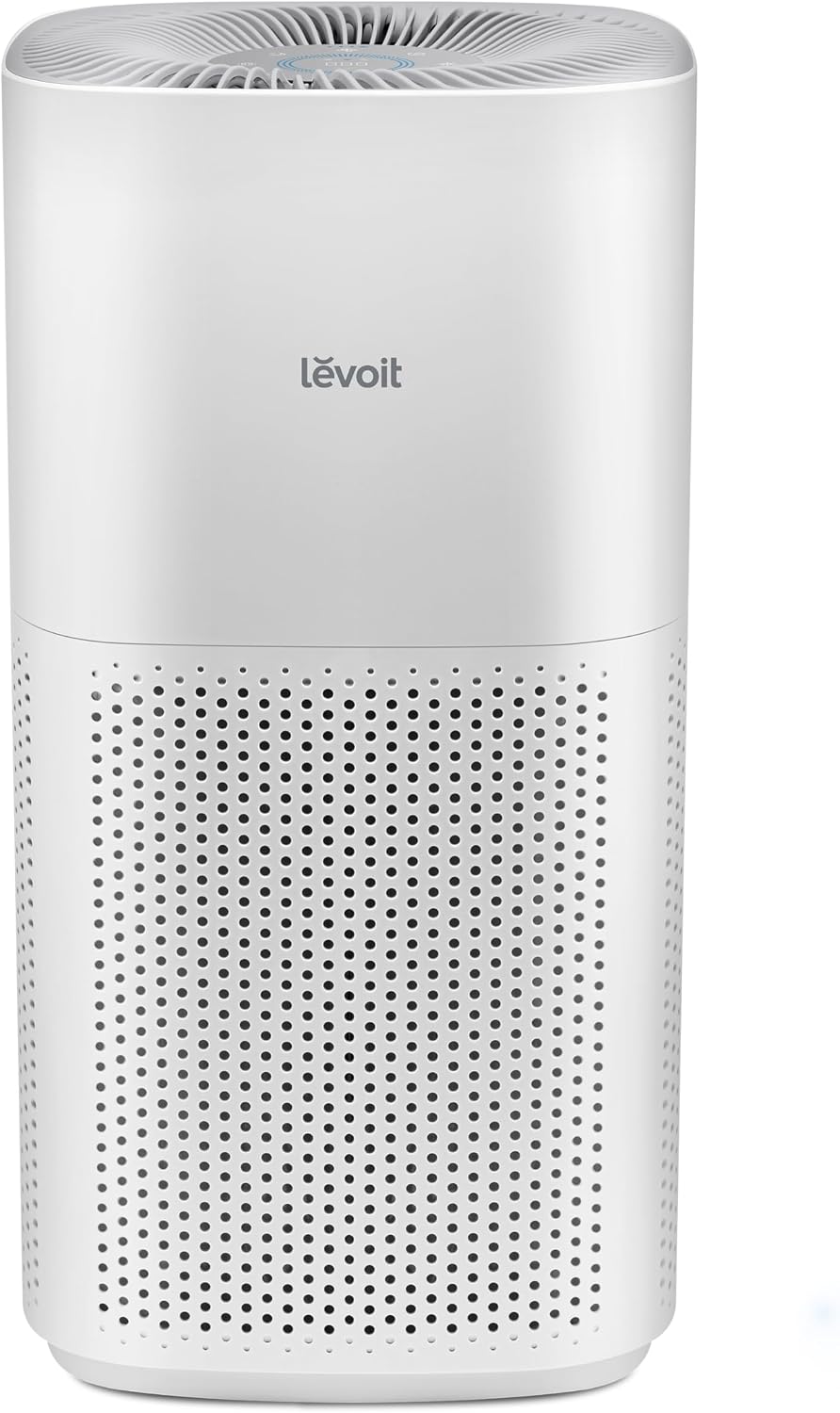
2. Levoit Core 300 — 24 dB
No display, no Wi-Fi, no app — just a purifier with three buttons (Power, Fan, Timer). The lack of a display is a bonus for light-sensitive sleepers. At 24 dB on low, it’s quieter than a whisper.
Best for: Light-sensitive sleepers who want a no-frills, display-free purifier.
3. Xiaomi Mi Air Purifier 4 Compact — 20 dB
The standard 4 Compact is also 20 dB on low. The OLED ring dims significantly on the lowest setting. The Mi Home app lets you set a schedule (e.g., turn on at 10 PM, turn off at 6 AM) so you don’t have to remember to do it.
Best for: Mi Home users who want smart scheduling for their nighttime purifier.
4. Levoit Core 300S — 24 dB
The smart version of the Core 300. Same 24 dB noise floor, but with Wi-Fi, a companion app, and Alexa/Google voice control. The app’s “Sleep” mode dims the display and locks out high-speed settings.
Best for: Alexa/Google users who want voice control without getting out of bed.
The 90-day sleep protocol
Here’s what we recommend for the first 90 days of using a purifier in your bedroom:
Week 1–2 (Adjustment period):
- Run the purifier on auto mode all night
- Note your sleep quality in the morning (do you wake up feeling fresher?)
- If the display bothers you, use the app to dim or turn it off
Week 3–8 (Optimization):
- Switch to low mode all night (auto is fine, but low is quieter)
- Clean the pre-filter (if washable) once a week
- Note any changes in morning symptoms (headache, congestion, dry throat)
Week 9–12+ (Maintenance):
- Run on low or auto mode (your preference)
- Check the filter monthly — replace when the app says to (or when it looks dark)
- The purifier should be a forgotten, background presence by now
Common mistakes
- Running on high all night — It’s louder and wastes energy. Use low or auto.
- Never cleaning the pre-filter — A clogged pre-filter loads the HEPA faster, making the purifier less effective and noisier over time.
- Ignoring the display — A bright display suppresses melatonin. Use sleep mode or turn it off.
- Buying a purifier that’s too big — A 500 sq ft purifier in a 150 sq ft bedroom is overkill. You’ll be paying for CADR you don’t need, and the unit might be louder than a correctly-sized one.
- Not running it consistently — A purifier that’s only on for 2 hours a night won’t make a meaningful difference. Run it all night.
The bottom line
A quiet air purifier (under 30 dB on low) run all night in your bedroom will measurably improve your sleep quality — fewer allergy symptoms, less nasal congestion, and a cleaner breathing environment. The energy cost is negligible (1–3 cents per night), and the noise is inaudible.
The best pick for most people: The Xiaomi Smart Air Purifier 4 Compact (2024) at 20 dB — the quietest smart purifier we’ve tested, with a display that dims in sleep mode. If you want something even simpler, the Levoit Core 300 (no display, 24 dB) is the best no-frills option.